TL;DR. A transformer’s opaque serial depth scales with its number of layers, $\sim L$ (up to log factors). Any longer serial computation has to go through the tokens it writes. For illustration, I briefly discuss a subtly different, hypothetical kind of attention that reads the layer it is writing. That variant would have greater opaque serial depth, $\sim L+T$.
On the 80,000 Hours podcast, Rohin Shah describes today’s transformers as wide but shallow. A single forward pass does an enormous amount of work in parallel, but only a handful of steps in sequence. Reasoning that needs a longer chain has to spill into the chain of thought, where it can be read. That is a big part of why he is cautiously optimistic about chain-of-thought monitoring. In a paper with Jonah Brown-Cohen and David Lindner, he makes the intuition precise as opaque serial depth: the longest computation a model can do without interpretable intermediate steps.
Definition. Depth is circuit depth, the longest path through a circuit of binary associative ops and piecewise-analytic scalar functions. It is minimised over polynomial-size circuits, and in practice upper-bounded. A sum over $n$ inputs costs $\log_2 n$. Tokens (input, output, chain of thought) count as interpretable, and only paths between them count.
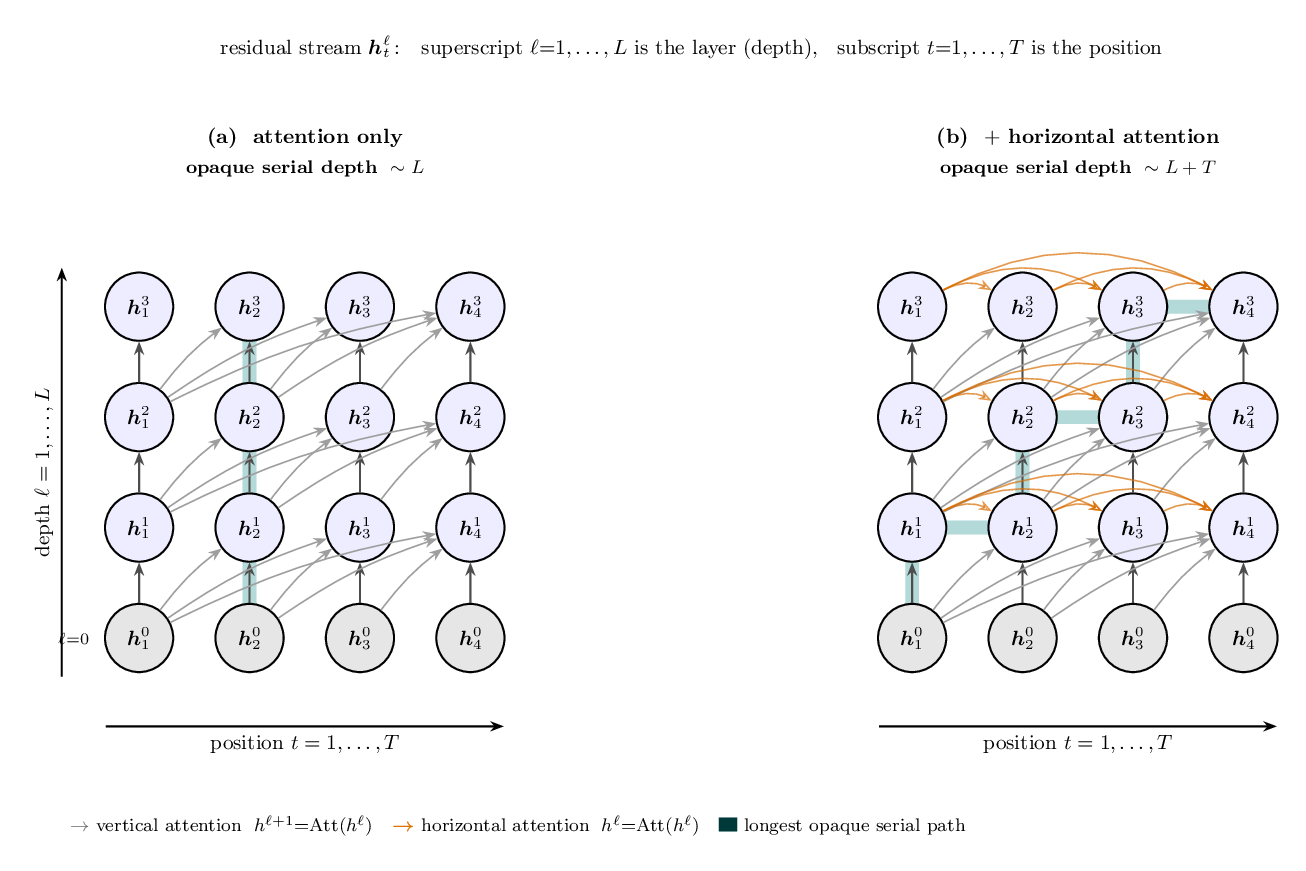
Transformer (a). An opaque path through the residual stream $\boldsymbol h^\ell_t$ can only go up or right. Every attention edge also climbs a layer, so a path has at most $L$ steps, each costing $\textcolor{gray}{O(\log T + \log D)}$:
$$\text{depth} = O\big(L\,\textcolor{gray}{(\log T + \log D)}\big).$$So a longer context barely helps. The only edge back down to layer 0 runs through a sampled token. Hence any computation in (a) that needs more serial depth than one forward pass provides ($\sim L$ layers) must be exposed in the emitted tokens (though it might be obfuscated). Those tokens may be compressed or steganographic, but they travel through a channel we can see.
Recurrence (b). Let position $t$ read earlier positions within its own layer. Now a path can take $L$ steps up and $T$ steps right, $\sim L+T$ steps in total. The paper analyses RNN blocks, where each right step reads only $t-1$ and costs $\textcolor{gray}{O(\log D)}$:
$$\text{depth}_{\text{RNN}} = O\big((L+T)\,\textcolor{gray}{\log D}\big).$$Panel (b) and the code below use a hypothetical same-layer attention instead. Each of its steps still sums over up to $T$ positions, so its depth is $O\big((L+T)\,\textcolor{gray}{(\log T+\log D)}\big)$. Either way, $T$ now enters linearly.
In code, take causal linear attention (no softmax), $\mathrm{Att}(\boldsymbol h)_t = \sum_{t'\le t} (\boldsymbol q_t \cdot \boldsymbol k_{t'})\, \boldsymbol v_{t'}$:
T, D = 8, 16                               # positions, width
W_q, W_k, W_v = (np.random.randn(D, D) / D**0.5 for _ in range(3))  # each (D, D)

def attn(h):                               # h: (t, D) -> (t, D)
    q, k, v = h @ W_q, h @ W_k, h @ W_v    # each (t, D)
    return np.tril(q @ k.T) @ v            # (t, t) causal scores @ (t, D) -> (t, D)

h0 = np.random.randn(T, D)                 # (T, D) token embeddings
The only difference between the two is where a layer reads from:
(a) attention only
h1 = attn(h0)  # (T, D) <- finished h0
h2 = attn(h1)  # (T, D) <- finished h1
h3 = attn(h2)  # (T, D), all t parallel
# depth ~ L
(b) + horizontal attention
h1 = attn(h0)                   # (T, D)
for t in range(T):              # serial in t
    h1[t] = attn(h1[:t+1])[-1]  # (t+1, D) -> (D,)
# repeat per layer; depth ~ L + T
That is linear in context, so long reasoning can stay hidden in the activations. This is why recurrence matters for safety: it would take away the guarantee that deep reasoning shows up in the output.
arXiv:2603.09786 · code · figure PDF / TikZ.